Why the Internet Is Slower During Peak Hours (And What Actually Happens Behind the Scenes)
If you’ve ever tried watching YouTube at night, playing PUBG after dinner, or joining a Zoom class during college hours, you’ve probably noticed one thing — internet becomes slow.
Webpages take time to load, videos buffer, payments lag, multiplayer games jitter, and everything feels frustrating. But why does this happen only at certain hours? And what’s actually happening behind the scenes?
Let’s break it down in simple human language, without networking jargon.
🕒 What Are Peak Hours?
Peak hours are the times when maximum users are online and consuming bandwidth.
In most Indian households, peak hours look like:
-
8 PM – 11 PM (after dinner entertainment)
-
10 AM – 1 PM (online classes / WFH)
-
5 PM – 9 PM (gaming + streaming + video calls)
During these hours, usage shoots up because:
✔ Families are home
✔ Students are online
✔ Offices are running meetings
✔ OTT streaming happens
✔ Gaming servers are full
In short:
More users → Same bandwidth → Slower speeds
But that’s just the surface. Real story is deeper.
🌐 Reason #1: Shared Bandwidth (You Don’t Have a Dedicated Pipe)
Most home broadband connections use a shared infrastructure.
Imagine society building has:
-
100 flats
-
1 water tank
Everyone shares the same water line.
If all 100 families fill buckets at the same time — water pressure drops.
Internet works the same:
More neighbors online → Less bandwidth per person
This is especially true for:
-
Fiber-to-building connections
-
Cable broadband
-
Wi-Fi hotspots
-
Mobile networks (4G/5G)
🏢 Reason #2: ISP Congestion (Network Traffic Jam)
Your ISP (Airtel, Jio, BSNL, Hathway) carries data through backbone networks.
During peak hours:
-
More streaming
-
More video calls
-
More downloads
-
More cloud usage
This creates something called congestion.
Think of it as a traffic jam on a highway:
-
Highway = ISP backbone
-
Cars = data packets
-
Traffic jam = high latency + slow speed
Even if you have 200 Mbps connection, congestion slows you down.
🎥 Reason #3: Streaming Services Cause Massive Load
OTT platforms like:
-
YouTube
-
Netflix
-
Amazon Prime
-
Hotstar
-
JioCinema
use huge bandwidth because they serve HD/4K content.
One 1080p stream consumes around:
✔ 3–6 Mbps continuously
Imagine 10 million people streaming cricket at 8 PM — total bandwidth consumed is insane.
This overloading makes network slower nationwide.
🗺️ Reason #4: Distance From Content Delivery Networks (CDN)
Most websites and apps don’t serve content from one server — they use CDNs.
CDN = Content Delivery Network
It stores videos/images/pages closer to users.
But when CDNs are:
-
Busy
-
Overloaded
-
Geographically far
-
Under-provisioned
Then data takes longer to reach.
Example:
During IPL or FIFA, even CDNs get hammered.
📶 Reason #5: Mobile Networks Have Limited Spectrum
4G/5G networks share radio spectrum.
Spectrum = Highway lanes in wireless world.
More people in:
-
Colleges
-
Offices
-
Malls
-
Apartments
= More devices sharing same spectrum.
This causes:
-
High latency
-
Packet loss
-
Lower speeds
That’s why mobile internet is slower in:
✔ Public places
✔ Apartments
✔ Hostels
✔ Metro cities
Compared to villages where tower load is low.
💻 Reason #6: Wi-Fi Router Limitations at Home
Sometimes issue isn’t ISP — it’s your router.
Peak hours mean:
-
More families online
-
More devices connected
Modern homes have:
-
Phones
-
Laptops
-
Smart TVs
-
Alexa
-
Cameras
-
Tablets
Most cheap routers (especially ISP-provided ones) choke under load.
Routers have limits in:
✔ Processing power
✔ Range
✔ Channels
✔ Antenna quality
So speeds drop even if ISP is fine.
🏢 Reason #7: Server-Side Load (App Backend Overwhelmed)
Sometimes internet feels slow but actual problem is app’s own servers.
Examples during peak:
-
UPI payments fail
-
Zomato/Swiggy lag
-
Big Billion Days crash
-
Movie ticket bookings freeze
Not your internet—backend server overload.
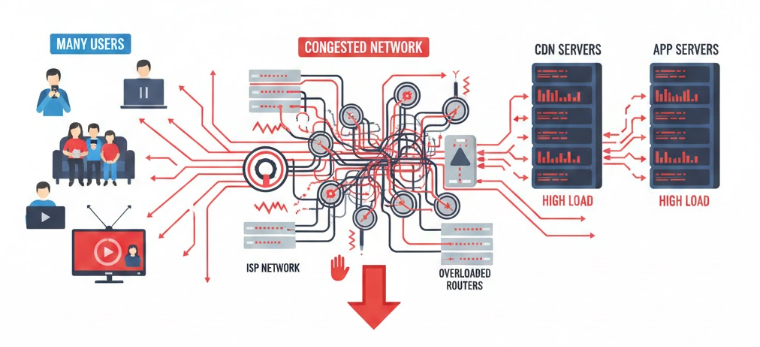
So peak hours affect client + ISP + CDN + server layers together.
🧩 What Actually Happens Behind the Scenes (Technical Breakdown)
During peak hours:
-
More devices send requests
-
DNS queries increase
-
ISP routers queue packets
-
CDNs cache more content
-
TCP congestion control kicks in
-
Packet loss increases
-
Retries slow down speeds
-
Streaming services lower resolution
-
Apps show loading screens
That's why:
✔ YouTube drops from 1080p → 480p
✔ Zoom lowers video quality
✔ Games show ping spikes
✔ Video calls freeze
🛠️ How ISPs Handle Peak-Time Load
ISPs use techniques like:
✔ Load balancing
✔ Peering agreements
✔ Traffic shaping
✔ QoS (Quality of Service)
✔ Cache servers
✔ Fiber upgrades
✔ BGP routing optimizations
Big ISPs even deploy Netflix + YouTube cache servers inside India to reduce load.
📝 So Why Doesn’t ISP Increase Bandwidth?
Because building more capacity costs:
-
Fiber cables
-
Bandwidth contracts
-
Data center racks
-
Power & cooling
-
International transit fees
Peak-time demand = expensive to handle.
That’s why ISPs manage capacity instead of overbuilding for extreme peaks.
🧠 Final Conclusion
Internet becomes slow during peak hours because:
✔ Too many users
✔ Limited shared bandwidth
✔ ISP congestion
✔ CDN overload
✔ Wireless spectrum limits
✔ Router bottlenecks
✔ App/server overload
In short:
“It’s not just your Wi-Fi — the entire internet ecosystem is busy.”