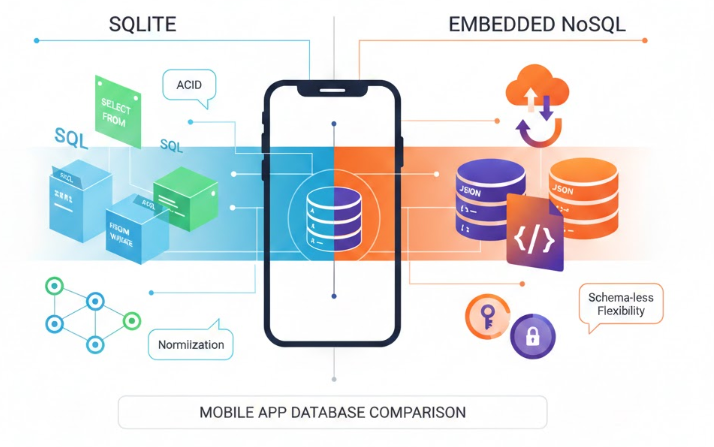
✅ SQLite vs Embedded NoSQL: How Modern Mobile Apps Store Data Offline
Mobile applications aaj sirf online services nahi dete, balki offline mode me bhi smooth experience provide karte hain. Chahe vo WhatsApp ho, Instagram, map apps, note-taking apps ya fitness tracking tools – sabme offline storage ka ek strong role hota hai. Isi context me do approaches ka naam sabse zyada sunne ko milta hai: SQLite aur Embedded NoSQL databases.
Is article me hum deep dive karenge ki SQLite kya karta hai, Embedded NoSQL ka kya role hai, aur modern mobile apps in dono ko kaise use karte hain. Saath hi, hum scalability, performance, data modeling aur developer experience ko bhi compare karenge taaki aapko ek complete picture mil jaaye ki kahan kaunsa solution better fit hota hai.
📌 Why Offline Storage Matters in Mobile Apps?
Saare mobile users har time network ya Wi-Fi ke upar dependent nahi ho paate. For example:
-
Rural/remote areas me network issue
-
Metro cities me underground travel
-
Flight mode usage
-
Battery saver mode me background network off
-
Limited data plans
In situations me agar app offline store karke baad me sync kar le, to user experience better ho jata hai. Isi liye offline-first architecture aaj ke time me popular ho chuka hai.
🏛 What is SQLite?
SQLite ek lightweight, file-based relational database hai jo SQL support karta hai. Ye serverless hai aur direct application ke sath bundle ho jata hai. Iska koi dedicated database server nahi hota.
Key Features
-
SQL-based relational model
-
Single file storage (no server)
-
ACID transactions supported
-
Small footprint (~500KB)
-
Reliable aur widely adopted
Android me to SQLite built-in aata hai, aur iOS me bhi Core Data ke through use hota hai.
📦 What is Embedded NoSQL?
Embedded NoSQL databases wo systems hote hain jo serverless NoSQL models ko mobile app me embed karte hain. Ye generally document-oriented, key-value ya graph formats support karte hain.
Popular examples:
-
Realm DB
-
Couchbase Lite
-
ObjectBox
-
RocksDB
-
LevelDB
Key Features
-
No fixed schema
-
JSON/document storage
-
Built-in sync capabilities (some)
-
Very fast reads/writes
-
Suited for dynamic data
NoSQL ka sabse bada advantage hai denormalization aur flexibility.
🔄 Data Modeling: Relational vs Document
Data modeling decision is key:
SQLite (Relational)
-
Data tables me split hota hai
-
Foreign keys, joins, indexes
-
Normalization required
-
Schema defined upfront
Example model:
User -> Posts -> Comments (three separate tables)
NoSQL (Document)
-
Data document me group hota hai
-
No joins (mostly)
-
Schema-less or dynamic schema
-
Nested objects allowed
Example document structure:
Denormalization se reads super-fast ho jati hain.
⚙️ Performance Considerations
Mobile devices ke andar CPU + storage constraints hote hain. Isliye performance important hai.
SQLite Performance
-
Small data sets ke liye fast
-
Complex queries handle kar sakta
-
Indexing strongly improves lookup
-
Write performance respectable
But joins + normalization overhead create kar sakta.
Embedded NoSQL Performance
-
Massive write speed
-
JSON/document serialization fast
-
Less CPU overhead
-
No JOIN = faster reads
-
Realms & ObjectBox use lazy loading
Isliye real-time syncing apps me fayda karta hai.
🔒 Synchronization & Offline-First
Ek modern mobile app mostly offline data ko cloud se sync karti hai.
SQLite me syncing
-
Manual logic required
-
Developer ko conflict resolvers create karne padte
-
No built-in sync
NoSQL me syncing
Some embedded NoSQL solutions like Couchbase Lite + Sync Gateway automatic conflict-resolution provide karte hain.
Example use cases:
-
Notes apps -> Evernote type syncing
-
Field apps -> Koi telecom survey etc
-
Messaging apps -> Offline message queuing
🎮 Developer Experience
SQLite
-
Developer ko SQL queries likhni padti
-
ORM tools (Room, SQFlite, CoreData) simplify karte
-
Schema migrations painful ho sakti
-
Errors often runtime me detect hote
NoSQL
-
Object-based APIs
-
Less boilerplate
-
No schema migration headache
-
JSON/document direct map ho jata
-
Change listeners support hota
-
Real-time updates available
Realm me to aap objects ko seedha observe kar sakte ho (reactive style).
📱 Use Cases Comparison
| Use Case | Recommended |
|---|---|
| Financial / Transaction apps | SQLite |
| Inventory systems | SQLite |
| Chat apps (real-time, sync) | NoSQL |
| Note-taking apps | NoSQL |
| Sensor/IoT data logging | NoSQL |
| Social media with feeds | NoSQL |
| Simple local storage apps | SQLite |
🔍 Real-World Examples
SQLite Usage
-
WhatsApp (chat backup + media indexing)
-
Telegram local caching
-
Browsers store history via SQLite
NoSQL Usage
-
Facebook Messenger uses distributed NoSQL
-
Realm used by Spotify, Netflix, Disney apps
-
Couchbase Lite used in enterprise field apps
🧩 Conclusion
Dono systems ka apna importance hai. SQLite relational integrity aur transactional workloads ke liye best fit hai jabki Embedded NoSQL dynamic, offline-first, real-time aur sync-based apps ke liye powerful hai. Future mobile architectures offline-first + cloud sync direction me move kar rahe hain — jaha NoSQL ecosystems zyada seamless solutions offer karte hain.
Modern apps binary choose nahi karti — they combine both!
Example: App feeds NoSQL me aur billing/invoices SQLite me.
Agar aap mobile developer ho to decision data model, sync need, performance, user experience aur flexibility pe depend karta hai.