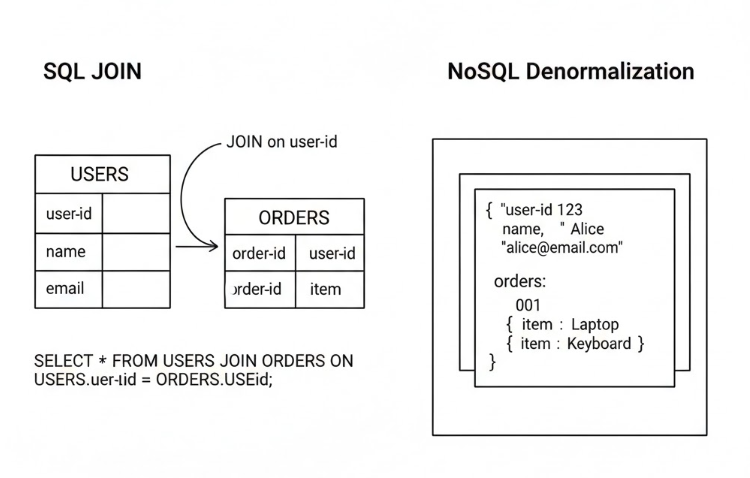
🟦 SQL and Normalization — A Quick Refresher
SQL databases follow Normalization rules.
Normalization simply means — don’t duplicate data unnecessarily.
For example, a Basic SQL design:
📂 Users Table
| id | name |
|---|---|
| 1 | Jay |
| 2 | Rohan |
📂 Orders Table
| id | user_id | product |
|---|---|---|
| 101 | 1 | Mobile |
| 102 | 2 | Laptop |
Here, Orders.user_id connects to Users.id.
When you want to fetch who ordered what, you do:
This is called a JOIN.
🔹 Why JOIN is important?
Because it:
✔ avoids duplicate user data
✔ ensures consistency
✔ saves storage
✔ allows complex analytical queries
SQL works best where relations are critical — like banking, ERP, e-commerce orders, HRMS, payments, etc.
🟩 NoSQL and Denormalization — The Modern Way
Now imagine a modern social platform like Instagram:
-
Each post has:
-
photo
-
caption
-
comments
-
likes
-
user info
-
timestamps
-
If you try to normalize this with SQL, you get:
-
User table
-
Post table
-
Comment table
-
Likes table
-
Follow table
And to render one post in feed, you will need:
-
SELECT post
-
JOIN user
-
JOIN comments
-
JOIN likes
-
JOIN follows
Too many JOINs → slow response → bad UX
That’s where NoSQL databases like MongoDB, DynamoDB, Firebase use Denormalized document design.
In NoSQL, a single document might look like:
No JOIN required.
Everything needed for UI is already bundled.
⚔ JOIN vs Denormalization — Practical Differences
| Feature | SQL JOIN | NoSQL Denormalization |
|---|---|---|
| Data Structure | Normalized | Embedded / Flattened |
| Queries | Complex joins | Single document fetch |
| Storage | Less | More |
| Write Speed | Slower (constraints) | Faster |
| Read Speed | Depends on joins | Very fast |
| Use Cases | Banking, ERP, Inventory | Social media, IoT, Chat apps |
| Consistency | Strong | Eventual (mostly) |
| Scaling | Vertical | Horizontal |
🚀 Performance Perspective
🟦 SQL JOIN performance
JOINs are heavy when:
❌ tables are very large
❌ indexes are missing
❌ too many JOINs are chained
❌ sharding or clustering is required
That’s why globally scaled systems often face JOIN bottleneck.
🟩 NoSQL Denormalization performance
Denormalization improves:
✔ read speed
✔ feed rendering time
✔ API response time
✔ horizontal scaling
✔ caching behavior
Platforms like:
-
Instagram
-
Twitter
-
TikTok
-
Reddit
-
Netflix
use denormalized models heavily for fast UI feeds.
📦 Real Examples That Help You Decide
🧾 E-Commerce Example
Cart + Checkout needs consistency:
-
cart items
-
address
-
coupons
-
payments
→ SQL fits well.
But product browsing (infinite scroll):
-
categories
-
filters
-
images
-
review counts
→ NoSQL caching or denormalization gives fast UX.
Therefore modern e-commerce uses:
✔ SQL for transactions
✔ NoSQL + Cache for browsing
🗺️ Food Delivery App Example
When showing orders on screen:
SQL JOIN would require:
-
Join Order → Restaurant
-
Join Order → Items
-
Join Items → Price
Too slow for real-time delivery tracking.
Denormalized NoSQL structure stores order like:
One fetch → Show UI → User happy.
🧠 2026 Best Practices: Hybrid Architecture
Smart companies don’t ask:
“SQL or NoSQL, कौन best है?”
They ask:
“Use case के हिसाब से कौन best है?”
Most real systems use both:
✔ SQL for consistency (transactions, accounting)
✔ NoSQL for performance (feed, logs, analytics)
✔ Redis for caching
✔ Kafka for event streams
This hybrid style is now common in:
-
Uber
-
Swiggy
-
Amazon
-
Flipkart
-
Netflix
🏁 Conclusion
SQL JOIN and NoSQL Denormalization are not enemies —
they are tools with different strengths.
✔ Use SQL JOIN when:
→ data is relational
→ accuracy matters
→ constraints are strict
→ schema is stable
✔ Use NoSQL Denormalization when:
→ reads must be fast
→ UI needs denormalized data
→ schema evolves frequently
→ scaling is priority
In 2026, the smartest engineers mix both instead of choosing one blindly.