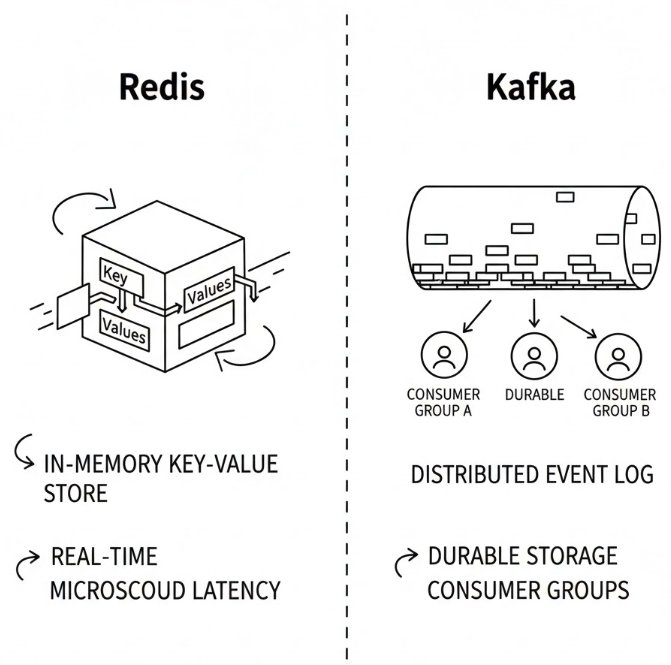
🚀 Redis vs Kafka: Which One for Real-Time Systems?
When developers talk about “real-time systems,” they’re usually referring to anything that needs to react right now, not after 5 seconds or 1 minute.
For example:
-
Live stock prices updating
-
Food delivery order status changing
-
Online gaming player movement
-
Chat messages appearing instantly
-
Real-time GPS tracking in Uber
-
Notifications on Instagram
To handle this kind of data, companies rely on tools like Redis and Kafka, but both solve very different problems.
Let’s break them down like developers actually understand.
🟥 What is Redis? — Simple Explanation
Redis is an in-memory data store, meaning data stays in RAM (not disk), making it extremely fast.
Think of Redis like:
✔ A temporary memory
✔ A cache layer
✔ A fast lookup table
✔ A shared “state” for applications
Redis can be used as:
-
Cache
-
Session store
-
Key-value store
-
Pub/Sub system
-
Rate limiter
-
Leaderboard engine
-
Queue (lightweight)
⏩ Speed Example:
RAM > SSD > HDD
So reading from Redis is like asking your brain, not checking your diary.
🟦 What is Kafka? — Simple Explanation
Kafka is a distributed event streaming platform.
It stores messages (events) in logs so other systems can read them later.
Think of Kafka like:
✔ A pipeline for events
✔ A history log of everything that happened
✔ A broadcaster for multiple subscribers
Kafka is used for:
-
Real-time analytics
-
Event logs
-
Metrics processing
-
Stream processing
-
Data pipelines
-
Microservices communication
Key point: Kafka persists messages by default, Redis does not (unless configured).
⚔️ Redis vs Kafka — Core Concept Difference
| Feature | Redis | Kafka |
|---|---|---|
| Main Use | Cache / Fast data | Event streaming |
| Storage Type | In-Memory | Disk-based commit log |
| Message Retention | Short-lived (optional) | Long-term |
| Ordering | Not guaranteed everywhere | Strict ordering |
| Scaling | Vertical + Clustered | Distributed horizontal |
| Subscribers | Pub/Sub real-time | Consumers groups |
| Latency | Microseconds | Milliseconds |
| Data Replay | No | Yes |
| Durability | Low (by default) | High |
🧠 Simple Analogy (Easiest Way to Remember)
📌 Redis = Short-term memory
→ Fast access, fast forget.
📌 Kafka = Recording system
→ Store everything, replay later.
Imagine a cricket match:
-
Redis = Live score on screen (fast, current state)
-
Kafka = Full commentary recording (history, replay)
That’s the difference.
🛠️ Real Use Case Comparisons
🟩 Use Case 1: Real-Time Leaderboard (Gaming)
Game needs to show:
-
Top players
-
Current score
-
Live ranking
Players’ scores update very frequently.
Redis is perfect here because:
✔ Fast updates from memory
✔ Sorted sets available
✔ Microsecond latency
Example:
Pubg / BGMI / Valorant style games.
Kafka is not required here, because we don’t need history of every score update.
🟦 Use Case 2: Food Delivery Tracking (Swiggy / Zomato)
There are two needs:
-
Live tracking (rider location)
-
Analytics later (rider speed, order delays)
So companies do:
✔ Redis → Store current location + ETA
✔ Kafka → Store all events (for analytics)
Redis handles now, Kafka handles what happened.
🟩 Use Case 3: Chat Systems (WhatsApp-like)
For chat:
-
Messages need to go instantly
-
Online status needs to update
-
Typing indicators are rapid signals
Redis Pub/Sub works great for:
✔ Typing indicators
✔ Online/offline presence
✔ Chat reading (fast cache)
But Kafka helps in:
✔ Message storage
✔ Delivery tracking
✔ Analytics
Again both used together.
🟦 Use Case 4: Stock Market + Trading
Stock price updates come extremely fast.
Redis handles:
✔ Current price
✔ Order book cache
✔ Fast lookup for UI
Kafka handles:
✔ Price event history
✔ Analytics (ML/Algo trading)
✔ Data replay for compliance
Trading platforms must store who bought what — Kafka is perfect for that.
🧩 So When Should You Use Redis?
Choose Redis when you need:
✔ Ultra-low latency (<1ms)
✔ Fast read/write
✔ Shared state
✔ Cache layer
✔ Session management
✔ Rate limiting
✔ Leaderboards
✔ Counters
Examples:
-
Session tokens for login systems
-
Cart data in e-commerce
-
API rate limiting
-
Real-time counters (likes, views)
-
Feature flag storage
Redis is basically for fast stateful data.
🧩 So When Should You Use Kafka?
Choose Kafka when you need:
✔ Event streams
✔ Audit trails
✔ Historical replay
✔ Distributed consumers
✔ Data pipelines
✔ Microservices communication
✔ Stream processing
Examples:
-
Fraud detection systems
-
Payment event systems
-
Metrics pipelines (Prometheus, Loki, etc.)
-
ML feature pipelines
-
Clickstream analytics (Google Analytics type)
Kafka is basically for event flow and history.
🔀 Why Modern Systems Use Both Together
Most scalable companies combine them:
✔ Kafka handles the logs & events
✔ Redis handles the current state
This combo exists at:
-
Netflix
-
Uber
-
Swiggy
-
Amazon
-
Flipkart
-
Meta
Example:
Uber rider location → Redis (current view)
All rider pings → Kafka (history + analytics)
Result:
→ Fast UI + deep analytics
🏁 Conclusion
Redis and Kafka are not competitors —
they solve completely different problems.
✔ Use Redis for:
→ caching, real-time values, current state, low-latency lookups
✔ Use Kafka for:
→ durable event logs, stream processing, replay, analytics
If your app needs real-time + history,
combine both, just like modern systems in 2026.